

Gerald's Game: The Impossible Adaptation
Spring of King #7

I am once again thrilled and chilled to join the Scarestack Society ka-tet, this time for Spring of King, where us Scarestackers will be covering Stephen King adaptations all May long. Many thanks to our fear-full leader, Kyle Ryan, for putting this together.
As someone who dabbles in both literary and cinematic horror, I’m especially excited for this series. Flanafan that I am, I chose to cover Mike Flanagan’s adaptation of Gerald’s Game.
But first, a little of my own history with Mr. King.
I cut my teeth in the 90s and early 2000s, and was an avid reader. My grandma was a thrifter, and would keep me and my brother busy by letting us pick out as many books as we wanted. This was back when a secondhand paperback cost a dime, and we would literally fill a cart.
(I have a lot to thank my grandma for. My love of reading led to my love of writing, and without her it’s safe to say that there would be no H. H. Duke.)
You know what thrift stores had a lot of in the late 90s? Stephen King paperbacks. No one was auditing my book hauls, either. Carrie, Misery, It, The Gunslinger, Pet Sematary, The Shining… probably not the best reading material for a nine-year-old. The nineties were a different time.
But Stephen King instilled in me a love of the spooky, dark, and macabre that persists to this very day.
Gerald’s Game: The Impossible Book
Gerald’s Game was published in 1992, eighteen years and thirty-one books after King’s breakout debut hit Carrie.
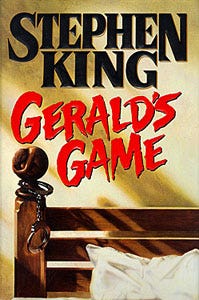
Gerald’s Game centers Jessie, a passive housewife who, in an attempt to please her husband, agrees to play a sex game involving handcuffs at their secluded summer home. Unfortunately for Jessie, her husband suffers a massive heart attack and dies, leaving her handcuffed to the bed with little hope of rescue. The majority of this book takes place in one room, with one character.
Now, Stephen King makes executing this premise seem effortless. And for King it probably was. But writing a one-character, one-location story that spans 330 pages… that’s difficult. How do you keep tension rising and your reader engaged when you can’t change locations or add new characters?
King manages this by going inside Jessie’s mind, forcing her to confront a traumatic sexual assault by her father during an eclipse when she was nine years old. There is a direct through-line from that situation with her father to the rape fantasy her husband so badly wanted to play out, and that is what King explores in this book. He makes this seem like an obvious move–but actually pulling that off and forming the structure to have a compelling story, is quite a feat.
This book should not work. But it does.
The Impossible Adaptation
Gerald’s Game is an impossible book, but its format has a lot going for it. The written word lends itself well to introspection, to going inside a character’s mind and experiencing their inner world. It’s literature’s biggest advantage over cinema.
So it would seem that adapting Gerald’s Game into a movie would be nearly impossible. How do you convey the meat of the story in a way that translates well on film? Through voiceover? Just hoping that your audience picks up on subtle clues? Good luck with that.
Enter Mike Flanagan, who had the genius idea to personify Jessie’s thoughts through hallucinations of her dead husband, played by Bruce Greenwood, and an idealized version of herself. Greenwood represents the negative side of Jessie’s mind, the part influenced by years of abuse and belittlement–first by her father, then her husband. The vixen-like hallucination of herself is smart, dogged, and perfectly coiffed–a far cry from the cowed, passive person handcuffed Christ-like to the bed.
It’s a real devil on one shoulder, angel on the other type of a situation.
It must be noted that Gerald’s Game is not only Mike Flanagan’s first King adaptation, but his first adaptation period. This was the proving ground for Doctor Sleep, Life of Chuck, the upcoming Carrie series, and hopefully someday the Dark Tower series. Without this movie, we would not have gotten The Haunting of Hill House, The Haunting of Bly Manor, nor The Fall of the House of Usher. Flanagan has earned a reputation as an adaptation man, and it all started here.
Performances
Can we talk about Bruce Greenwood and Carla Gugino for a minute? Flanagan is known for using the same actors in each of his projects, and these are two of his favorites. This was the first Flanagan project for both.
Gugino obviously shines as our protagonist. In fact, she’s basically playing two different characters–the cowed, increasingly disheveled Jessie tied to the bed, and the confident, siren-like version talking her through her survival.
Greenwood does just as good of a job, and he is also tasked with the more nuanced material. He, too, plays two characters–Jessie’s husband and the version of him that lives in Jessie’s head. The differences are subtle, but the version in Jessie’s head is more sinister, more critical of her. It’s never stated outright, but this is how Jessie sees the man she’s chosen to spend her life with.
Bruce Greenwood gets both of the major stereotypical Mike Flanagan monologues. Here’s the text of one about a macabre figure that enters Jessie’s room at night, and she believes may be death coming to collect her.
“The forensics team will wince and nod, and tell themselves the woman on the bed died hard, but they won’t know the half of it. The reason your eyes are staring and your mouth screaming is because of what you saw at the end coming out of the dark. They’ll take you to the medical examiner. … in the end he’ll just call it “death by misadventure.” …. the gentleman had a heart attack at a critical moment, and the woman was left to… well, it’s best not to get into it. Just say the lady died hard. You only need to look at her to see that.”
I really wish this scene was available on Youtube, because while the dialogue is killer on its own, you don’t get the lilting, almost gentle way Greenwood delivers these lines. He is eating this monologue up, nestling and caressing Jess like a lover as he describes what she’ll look like when her body is discovered, the camera going horizontal so that the two actors are vertical even though they’re lying on a bed.
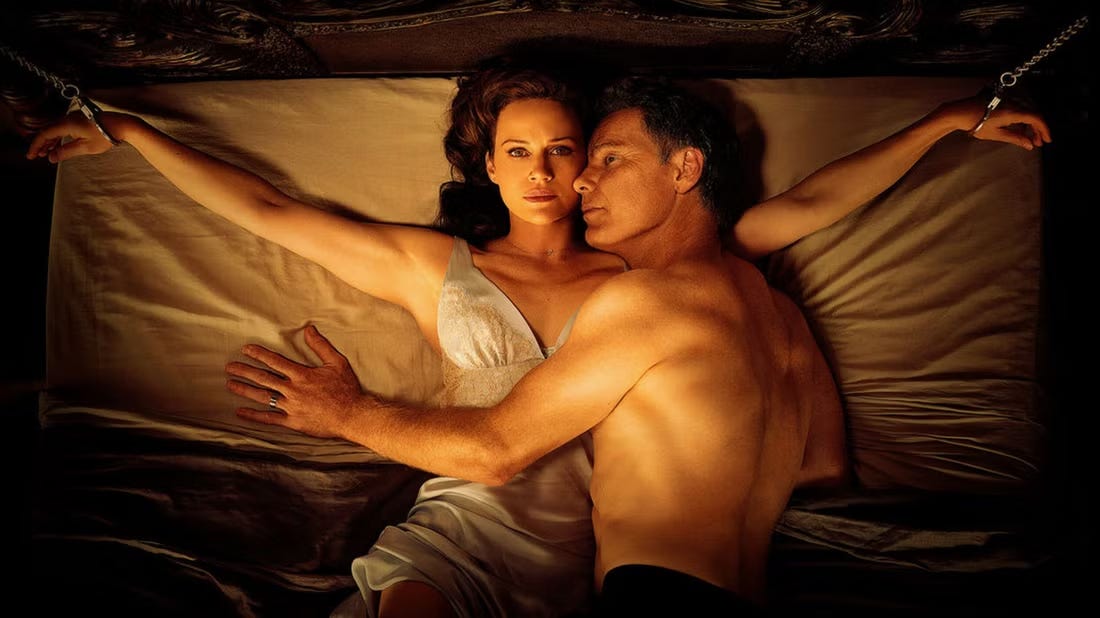
And this is Jessie having these thoughts. This is her fear about what is going to happen to her if she doesn’t get out of the handcuffs. It’s interesting to note that we don’t see the hallucination of herself at night, only Gerald.
Chiara Aurelia and Henry Thomas are given smaller, if just as demanding parts as childhood Jessie and her father. Henry Thomas plays against type here, and watching him connive to get his daughter alone and then manipulate her into silence afterwards made me sick to my stomach.
Kate Siegel’s performance as Jessie’s mother is her least-impressive to date, but that’s due entirely to there not being much to the part in the first place.
The Light and the Dark: The Symbolism of Gerald’s Game
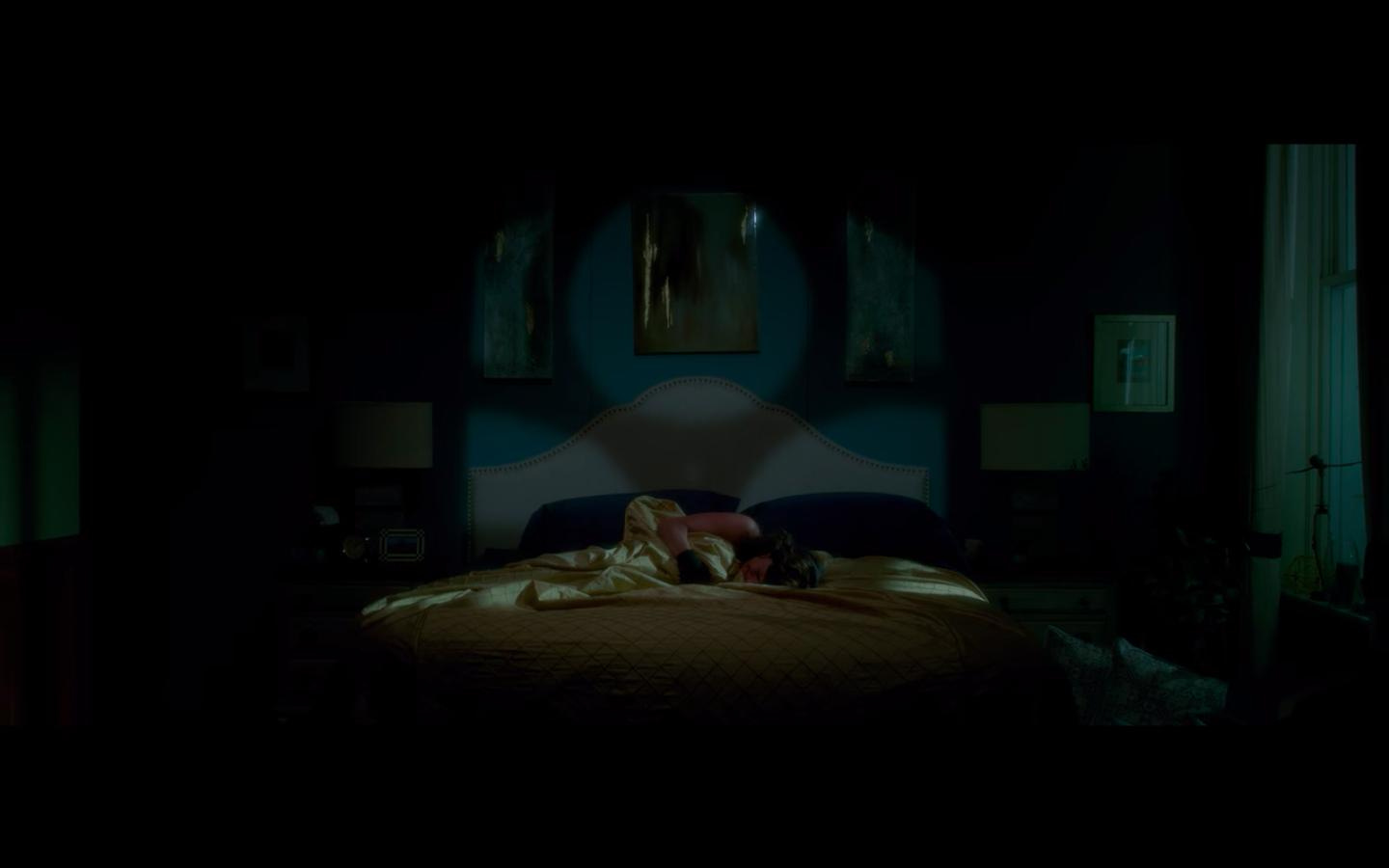
One of my favorite elements of Gerald’s Game is the use of light as a metaphor. While the story is externally about how Jessie survives the ordeal of being handcuffed to a bed, it’s internally about Jessie being sexually assaulted by her father.
This assault took place during a total eclipse of the sun. The sudden darkness at the exact moment of her father’s transgression represents Jessie’s loss of innocence, of her being plunged into a world of male dominion and mistreatment. We never see the moon fully transit away from the sun, symbolizing that Jessie has never dealt with this trauma, and still resides in this world of darkness.
The moonlight man, a grotesque figure Jessie sees in the corner of her room only at night, is an extension of this. “You’re only made of moonlight!” She tells him. He represents both death and oppressive patriarchy, formed from the barely-lit darkness of her life. The moonlight man, who carries a box of bones, wedding rings, and other souvenirs he’s taken from his victims, is what happens when the perverse and sadistic desires displayed by her father and husband are taken to the extreme, when they are left unchecked.
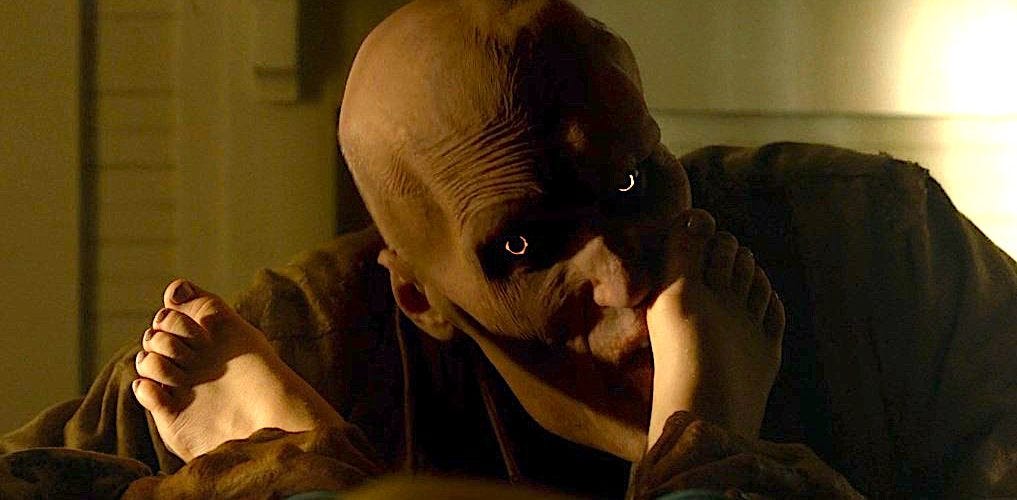
Another interesting element of Gerald’s Game is the stray dog that eats Bruce Greenwood’s body while Jessie watches helplessly from the bed.
There is a natural tendency to conflate the dog as another example of masculine oppression–they refer to it as he, and there’s at least one reference to men being like dogs, and dogs are going to do what dogs are going to do. A more apt take is that the dog is a foil for Jessie herself. The dog isn’t eating Gerald’s body because it’s trying to oppress him, but because it’s hungry and it needs to eat.
The men of this story–Gerald, Jessie’s father, and the moonlight man–do the awful things they do because they want to. Jessie and the dog do the (arguably less awful) things they do to survive.
“That dog’s just doing what it needs to do to get along,” Jessie’s hallucination of her most competent self tells her, “And you need to do the same.”
In the book, the dog’s victimhood is even more textual. We’re given an entire section in the dog’s POV, where we’re shown that the dog was once a beloved housepet until the father of the family he belonged to decided he didn’t want to pay the registration fee, and therefore abandons him by the side of the road. This man is not portrayed in a positive light–in fact, no man in the book or movie is, and it seems intentional.

Sticking the Landing
Shoot, I almost ended this and just now realized I didn’t mention probably the most infamous thing about this movie–and this is the closest thing to a spoiler in this review–the degloving. Yes, Jessie gets out of the handcuffs by literally stripping the skin off of her hand. It’s just as awful and wince-inducing as it sounds.
What I love about this is that the story ties together so perfectly. Her subconscious has been forcing her to relive her trauma for a reason. “You’ve had everything you needed to escape this whole time,” the childhood version of herself, still caught in the red light of the eclipse, says in one final hallucination, reminding Jessie how she’d cut her hand on a broken glass shortly after the eclipse.
If I have one qualm with this story, it’s that I think it should end when Jessie leaves the house. It seems cleaner that way, a true one-location story.
But Stephen King does what Stephen King wants.
H. H. Duke is a writer, author, and podcaster. Most importantly, she loves horror! Currently, she’s working on a book about a weird cave. OoooOOoo! For scary book recommendations, horror movie reviews, and other spooky things, subscribe to H. is for Horror now - If you dare!
Check out my other posts about Mike Flanagan here
Check out my other contributions to the Scarestack Society here
Spring of King continues with the following Scarestackers!
5/1 It miniseries- Sahar Khan
5/2 Pet Semetary- JHong
5/3 Pet Semetary 2- Horror Hangouts
5/4 Cujo- Kyle Ryan
5/5 Creepshow- B-Movie Tea
5/6 The Outsider- Sean Mo
5/7 Gerald’s Game- H. H. Duke
5/8 The Mangler- Timothy Atkinson
5/9 Maximum Overdrive- Yanni Hamburger
5/10 Salem’s Lot 2024- Meat Head Media
5/11 Silver Bullet- George R. Galuschak
5/12 Creepshow 2- Thehumangaze
5/13 Carrie- Hellish Views - Harry Evans
5/14 Christine- Emma
5/15 Big Driver- Molly O’Blivion &
Stand By Me- Matt Cyr
5/16 The Shining- Jamie B.
5/17 The Long Walk- Decarceration
5/18 King Of Home Video- Jean-Pierre Diez
5/19 The Langoliers- Beverley’s Horror Corner
5/20 Sleepwalkers- Brandon Rae
5/21 The Running Man- Stevie Duffy
5/22 Misery- Skyla
5/23 The Night Flier- Bryan Wolford
5/24 The Shawshank Redemption- Genevieve Brock
5/25 Dreamcatcher- Kimberly B🌴👻🌴
5/26 The Mist- Cedric
5/27 The Dead Zone- Offscreenshaman
5/28 Cat’s Eye- Backyard Movie Critic & Graveyard Shift- Liam Palmer
5/29 Rose Red- Kristen (Blood,Blush ,& Guts) & Storm Of The Century- Adam Hunter
5/30 It Chapter 1- That Horror Lesbian
5/31 Dolores Claiborne- Kimberly Ramsawak & The Lawnmower Man- Mike smith
I love Carla Gugino. She's so camp in The Fall Of The House Of Usher, but does siren so well even in 2023.
As The King (Kyle, he of 1K+ subscribers) is now busy attending to his royal duties, may I sire thee?
I hereby anoint thee, HH Duke, Duke of Scarestack, Lord of the Literary Macabre, Keeper of Horrors Both Earned and Imagined.
May your open rates be high, your comment sections delightfully unhinged, and your newsletters haunt readers long after the tab is closed.
The title is yours. You have been found worthy.
Rise, Your Grace.
This is one adapation , I havent seen yet. I think it is one of those movies I have to be in the right mood for but your post has convinced me